

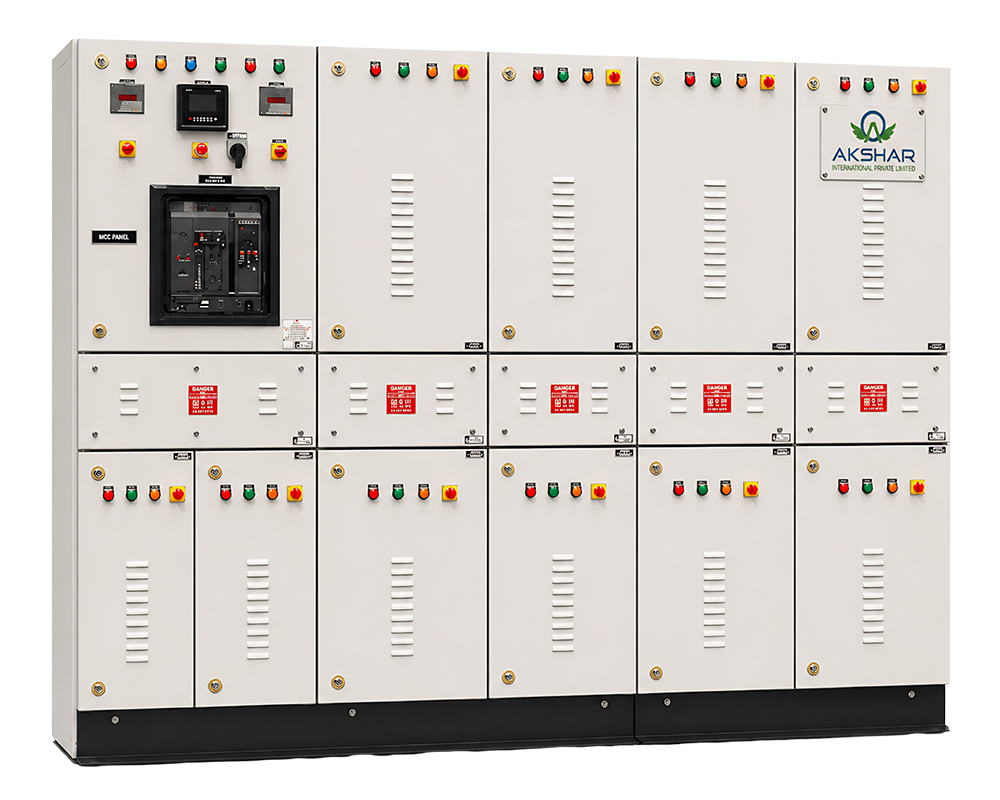
APFC Panel

APFC Panel (Automatic Power Factor Control Panel)

An APFC panel is used to automatically control and improve the power factor of an electrical system. It monitors the load conditions and switches capacitor banks accordingly to balance reactive power. This helps in maintaining efficient power usage and reducing unnecessary losses.

The panel is designed with proper control systems and protection devices to ensure stable and reliable performance. It improves overall system efficiency, reduces load on electrical equipment, and helps maintain voltage stability.

Application (Used for):
  • Maintaining and improving power factor
  • Reducing power losses in the system
  • Lowering electricity costs and penalties
  • Stabilizing voltage and system performance
  • Improving overall energy efficiency
Standard
What’s new Akshar’s Panel
Testing & Validation
Third-Party Inspection Support
Standard
  • IEC 61439-1 & 61439-2
  • IEC 60831 (Capacitors)
  • IEC 60947
  • IEC 60529
What’s new Akshar’s Panel

The following engineering drawings will be provided for approval before production:

General Arrangement (GA) Drawing
Panel layout with dimensions, component positioning, and section details.

Power Wiring Diagram
Detailed schematic of power connections ensuring proper load distribution and safety.

Control Wiring Diagram
Logical wiring diagrams for control circuits, interlocks, and automation sequences.

Bill of Quantity (BOQ)
Comprehensive list of components, specifications, and quantities used in the panel.

Testing & Validation

The following tests will be conducted and provided before dispatch:

  • Insulation Resistance (IR) Test
  • Continuity Test
  • Functional Testing
  • Power Wiring Verification
  • Control Wiring Verification
  • Visual Inspection
  • Tightness / Torque Check
  • Earth Continuity Test
  • Noise & Vibration Analysis
Third-Party Inspection Support

We provide full support for inspections carried out by customer-appointed or independent third-party agencies to ensure compliance with all technical and quality requirements.

Menu